Tropicalypse @ Dot Fiftyone Gallery by Francine Birbragher, Artnexus 2018
Gonzalo Fuenmayor presented the exhibition Tropicalypse in Dot Fiftyone Gallery's new space in Miami. The title of the exhibition, which combines the words "tropical" and "apocalypse", reflects an evolution of the theme he has been exploring until now using of symbols consid- ered "tropical" such as bananas, pineapples, toucans and palm trees. Although the works presented are related to previous ones when dealing with themes such as cultural hybridization, exoticism and identity, their conceptual approach and the use of new tools such as video and large format drawings present a darker and openly critical proposal. Through the new works, he questions how the idea of the exotic is created as a "brand" that is perpetuated and, in the process, it standardizes the idea of what is or should be consider exotic. According to Fuenmayor, "the exhibition was a pretext to create works that would talk about that internal and social negotiation of how the exotic or the tropical is perpetuated within the subconscious through video, photography and monumental drawings".1
At the entrance of the gallery the visitor finds a pair of pineapples placed on the ground in front of a yellow wall. When he approaches them, he realizes that the pulp of the fruits has been removed to create a sort of footwear. The pineapple, which in colonial America symbolized hospitality, is transformed in this context into a pair of slippers that can be used for walking or dancing, as can be seen in the video titled Frenzy (2017) presented in the project room. Frenzy is inspired by the gesture of adopting foreign cultural elements as their own and the absurdity that this appropriation or re-contextualization can lead to. According to Fuenmayor, "he is interested in what happens in the translation of customs and what is left without the possibility of translation."2 Hence the idea of producing a video in which the legs of a woman are seen performing a ballroom dance, a Charleston or a foxtrot, using pineapples as footwear instead of slippers. Produced in black and white, the three- minute video, whose title alludes to the impetus and disproportion with which the dancer (a former queen of the Barranquilla's Carnival) moves to try to follow the rhythm using fruits as footwear, ends with the pineapples completely shattered. The result is a comic, nostalgic and critical commentary on the processes of transculturation.
The image of the pineapples being used as footwear becomes an icon that is repeated on posters, photographs and drawings, including the charcoal Varieties of Truth (2017), part of a series of oval works in small format (45.72 x 60.96 cm) that alludes to a Victorian nostalgia
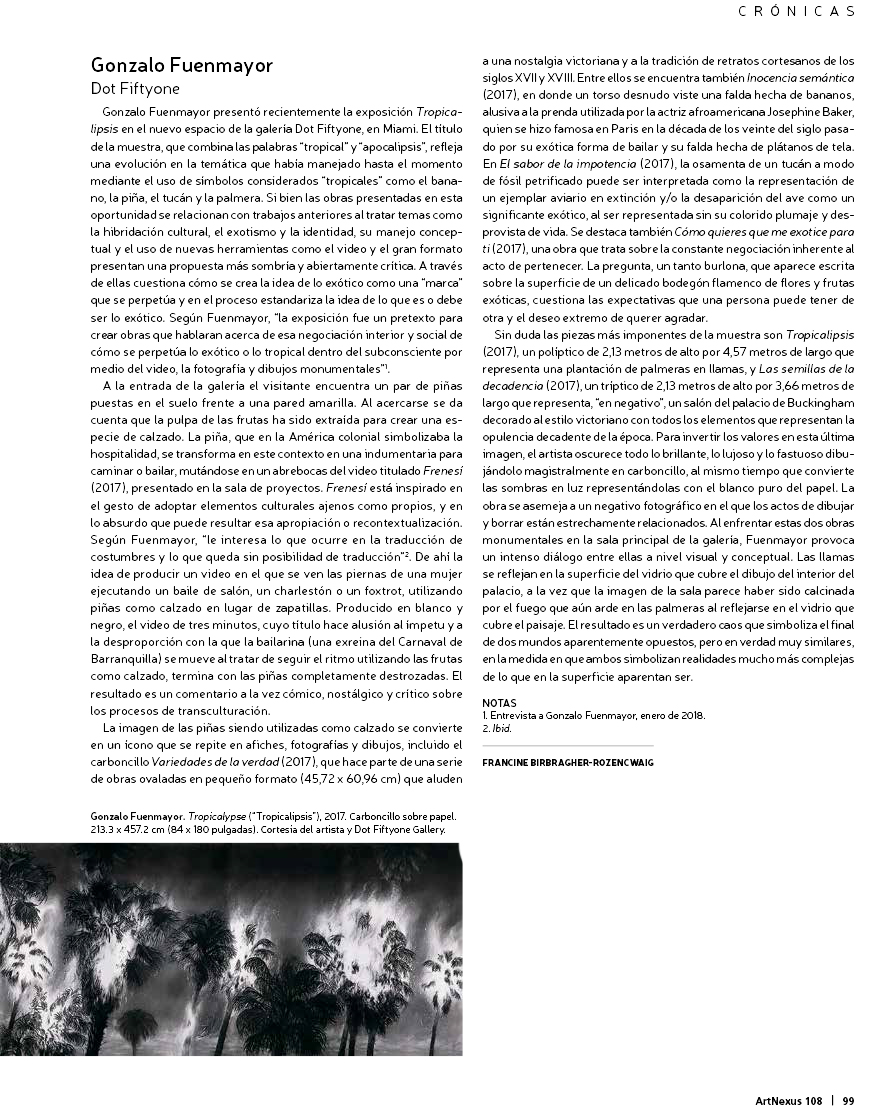
Gonzalo Fuenmayor. Tropicalypse, 2017. Charcoal on paper. 84 x 180 in. (213.3 x 457.2 cm). Courtesy of the artist and Dot Fiftyone Gallery.
and to the tradition of courtly portraits of the 17th and 18th centuries. Other works include Semantic Innocence (2017), in which a naked torso wears a skirt made of bananas, alluding to the garment used by the African-American actress Josephine Baker who became famous in Paris in the 1920s for her exotic way of dancing and her skirt made of fabric bananas; The Taste of Impotence (2017), in which the skeleton of a toucan as a petrified fossil can be interpreted as the representa- tion of an extinct specimen and/or the disappearance of the bird as an exotic signifier, represented without its colorful plumage and devoid of life. An outstanding work in this series is How would you want me to exoticize myself for you (2017), a drawing that addresses the constant negotiation inherent in the act of belonging. The question, somewhat mocking, that appears written on the surface of a delicate Flamenco still life of exotic flowers and fruits, questions the expectations that one person may have of another and the extreme desire to want to please.
Undoubtedly the most impressive pieces of the exhibition are Tropicalypse (2017), a polyptych measuring 2.13 meters high by 4.57 meters long that represents palm tree plantation in flames, and The Seeds of Decadence (2017), a triptych measuring 2.13 meters high by 3.66 meters long that represents, "in negative," one of Buckingham Palace's lounge decorated in Victorian style with all the elements that represent the decadent opulence of the time. To invert the values in this last image, the artist obscures everything bright, luxurious and lavish, drawing it masterfully in charcoal, while converting all the shadows into light, representing them with pure white paper. The work resembles a photographic negative in which the acts of drawing and erasing are closely related. By installing these two monumental works in front of each other in the gallery's main hall, Fuenmayor provokes an intense dialogue between them both at a visual and a conceptual level. The flames are reflected in the surface of the glass that covers the drawing of the interior of the palace while the image of the room seems to have been burned by the fire that still burns in the palm trees when reflected in the glass that covers the landscape. The result is a true chaos that symbolizes the end of two seemingly opposite worlds, but in truth very similar insofar as both symbolize realities much more complex than they appear on the surface.
NOTES
1. Interview with Gonzalo Fuenmayor, January 2018 2. Ibid.
FRANCINE BIRBRAGHER-ROZENCWAIG