We all have our Shadows
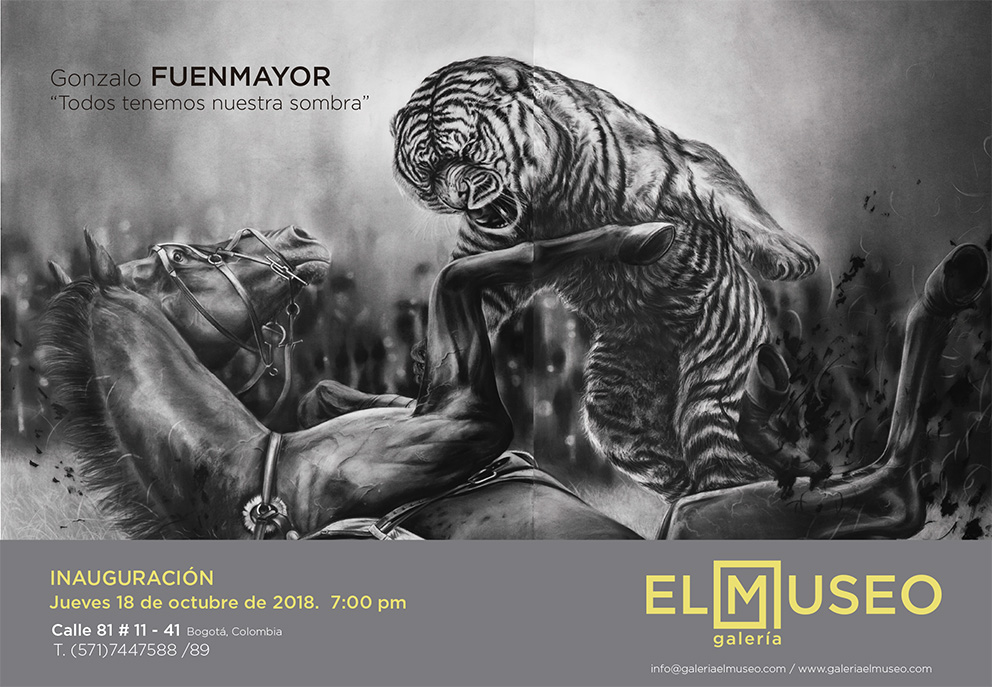
We All Have Our Shadows
It will suffice to come closer to the pieces titled "The Meddling of History" and "We All Have Our Shadows" (both included in this exhibition) to find oneself in front of a work, which is both magnetic and monumental. However, Fuenmayor is much more than a very talented draftsman. In times when it is difficult to remember artists who have great skills to carry out a job with technical expertise and, at the same time, something important to tell, his work stands out. Not only the quality of his drawings is intriguing, but also his enigmatic scenes which, sometimes with humor and a bit of sarcasm, connect two exuberant and apparently contradictory aspects, joined together in a single image, in order to trigger a series of associations that constantly confront and, simultaneously, define us.
It is an exuberance that seems romantic, exaggerated, hedonistic, and full of grandeur, and another one that seems wild, rugged, and natural; one that comes from European high cultures or from the recent, upstart U.S. social classes, and another one from the magical, quaint tropics. It unremittingly brings to mind the repertoire of symbolic and conceptual elements the Brazilian avant-garde of the early Twentieth Century described in its "Cannibalistic Manifesto": "Wagner founders in front of Botafogo's soccer fans." This dictum might as well be the title of one of his previous hybrid series made out of drawings and photography, in which luxuriant, dazzling chandeliers hang from blissfully self-abandoned muses and from their bunches of bananas.
The visual impact between these two so radically different splendors (industry and progress, on the one hand, and wilderness, on the other) produces a sense of oxymoronic absurd, which reminds us of Count of Lautréamont's Dadaist prediction when dictating the premonitory key of a ready-made: "As beautiful as the chance encounter of a sewing machine and an umbrella on an operating table." However, in the case of Fuenmayor this is not a chance encounter, but a premeditated one. In those images coexist two aspects of history that cannot be put asunder, presupposing the hybridization of our culture, because nature's history is the history of the hunger for wealth, which entails bonanza for some people and extermination for others. Colonization, landscape and culture inevitably depend on one another, so that behind every great civilization there is a stain that cannot be hidden: We all have our shadows.
And if in his charcoals this cultural hybridization becomes evident in a masterful way, through images that fuse a local identity with a global one ("Oh Glory," or "Rhetorical Weapon"), it is in the video, "Sisyphus," where the clash between two worlds operate in a more poetic way. Even though Man, and his millennia of civilizations (represented by a piece of domesticated wood, modeled and ergonomically put at the service of culture), tries to withstand the onslaughts of nature, it is nature, in its relentless and hazardous surge, that holds sway over him. From the encounter between the chair and the sea nothing remains but an everlasting friction between two forces shaping each other.
And while in the real world this purported progress seems destined to devour nature and condemn us to an end, Fuenmayor's auspicious work (as in Turner's or Caspar Friederich's Romanticism) is a maelstrom that defeats the death rattles of civilization. Power is inverted, and the image sometimes responds by becoming its negative. The splendor and the extravagance of the banquet inside a Victorian palace have been confined to the dark: The wild beast swallows the domesticated animal, and t he jungle devours the city.
As he has gone about in the past in his previous investigations, in We All Have Our Shadows Fuenmayor intelligently reconsiders the exoticism of the tropics, abolishes color as its preconceived and expected fundamental aspect, places history in conflict with the land and, above all, brilliantly embraces the extravagance of format, wilderness, and opulence.
Christian Padilla
Art historian and curator
Translated from the Spanish by Miguel Falquez-Certain